
Blog
Alma TED vs Hair Transplant: The Non-Surgical Difference

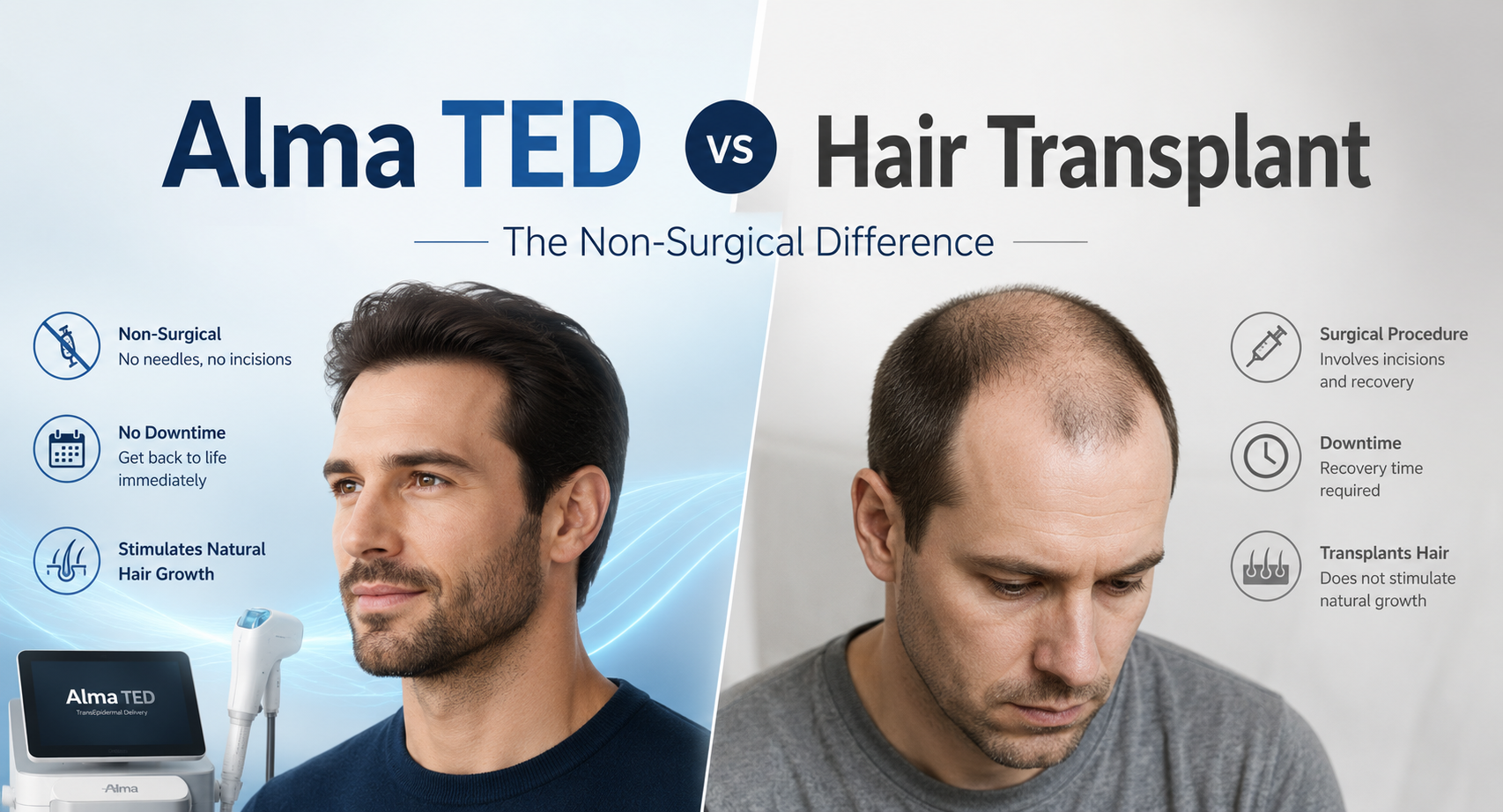
Five years ago, the hair loss conversation was simple: accept it, try minoxidil and finasteride, or fly somewhere for a transplant. Today the conversation is louder, less surgical, and far more interesting — driven by podcast hosts comparing their before-and-afters and a wave of new technology that doesn't require a single needle or scalpel.
One of the technologies leading that shift is Alma TED (TransEpidermal Delivery). At our Niagara Falls clinic, it's become one of the most-asked-about treatments, and the question that comes up at every consultation is the same: how does this actually compare to a hair transplant?
Here's the honest answer.
What is Alma TED?
Alma TED uses ultrasound combined with air pressure to deliver a topical hair growth serum deep into the scalp — without needles, without incisions, and without downtime. The acoustic waves create temporary micro-channels in the skin so active ingredients can reach the follicle. Sessions take 20–30 minutes.
No numbing cream. You drive yourself home. You can wash your hair the same day.
What is a hair transplant?
A modern FUE (follicular unit extraction) transplant surgically removes individual hair follicles from a donor area — usually the back of the head — and implants them into thinning or bald regions. The procedure runs 6–8 hours under local anesthesia. Recovery is real: small scabs at every transplant site, restrictions on exercise and sun for ~10 days, and visible early growth that doesn't look like the final result for 9–12 months.
Side-by-side comparison
Alma TEDFUE Hair TransplantAnesthesiaNoneLocalNeedlesNoneHundreds of micro-incisionsTime per session20–30 min6–8 hoursDowntimeNone7–10 daysSessions for results3 (typical)1 (sometimes 2)When you see results2–3 months9–12 monthsBest forThinning, early loss, female-pattern, post-partumEstablished baldness with stable donor areaResult typeStrengthens existing hair, awakens dormant folliclesAdds new hair where none existsPermanenceMaintained with periodic top-upsPermanent (transplanted hair resists balding)RisksMinimal — temporary scalp tendernessSurgical: infection, donor scarring, shock loss
Who's a candidate for each?
Alma TED works best for:
- Early-stage thinning where you want to act before a transplant becomes necessary
- Women with diffuse thinning (transplants work better for clear patterns than diffuse loss)
- Post-partum hair shedding
- Patients protecting an existing transplant
- Anyone who can't or won't do surgery — medical reasons, needle anxiety, time
A hair transplant works best for:
- Established bald areas where follicles are gone, not dormant
- Hairline redesign
- Patients with a clearly stable donor area
- People prepared for a 12-month patience timeline
Many patients start with Alma TED, get results they're happy with, and never go further. Others use TED as a maintenance tool after a transplant to protect their investment. There's no rule saying you have to choose one.
What to expect at a Niagara Falls Alma TED session
The first appointment includes a scalp assessment — often using Alma IQ Skin Analysis to baseline scalp condition and follicle density. The treatment itself:
- The scalp is gently cleansed
- A hair growth serum is applied to the treatment area
- The TED handpiece moves across the scalp for ~20 minutes (warm, vibrating sensation — most patients describe it as "weirdly relaxing")
- You leave. Same day. No restrictions.
We typically recommend three sessions, spaced about four weeks apart. Visible improvement starts around weeks 8–12. Maintenance is usually every 4–6 months after the initial course.
Realistic results timeline
Hair grows slowly. Don't expect to see anything in month 1. You may even see increased shedding in weeks 3–5 — this is the follicle cycling, and it's a sign treatment is working, not failing. New growth becomes noticeable around month 3 and thickens through month 6.
Frequently asked questions
Does Alma TED work for women?
Yes — it's particularly effective for diffuse female-pattern thinning, post-partum shedding, and post-menopausal hair changes.
Can I combine Alma TED with finasteride or minoxidil?
Yes. Many patients use Alma TED alongside oral or topical medications. We'll review your full regimen at consultation.
Will I lose new hair if I stop treatment?
Alma TED stimulates existing follicles — it doesn't graft new ones. If the underlying cause is still active, results gradually return to baseline without maintenance.
How much does Alma TED cost in Niagara Falls?
A standard three-session full-scalp package is significantly lower than a transplant. We provide exact pricing at your free consultation.
Is it painful?
No. No needles, no incisions, no recovery. The sensation is warm and tingling.
Ready to see if Alma TED is right for you?
Hair loss is personal, and the right answer depends on where you are in the journey. If you're in the early-thinning or "I want to act before this gets worse" stage, a non-surgical option deserves real consideration before surgery.
Book a free consultation at Pain Free Laser & Hair Restoration in Niagara Falls. We'll do a full scalp assessment with Alma IQ, walk you through what TED can realistically achieve for your specific pattern, and answer every question.
Read More Blogs!
Stay updated with the latest blog posts and engage with our community.